



Becoming a commercial pilot is a complex but rewarding career path, especially with a high demand for pilots. Boeing projects a need for over 600,000 new commercial pilots globally in the next two decades, leading to competitive salaries and growing opportunities.
Who Can Apply? Basic Eligibility Requirements
The first step is confirming that you meet the foundational requirements set by the Federal Aviation Administration (FAA). Here’s what you’ll need to satisfy before anything else:
- Age: You must be at least 18 years old to hold a Commercial Pilot Certificate. If you’re pursuing an Airline Transport Pilot (ATP) certificate—required for captains at major airlines—the minimum age rises to 23.
- Language: You must be able to read, speak, write, and understand English fluently.
- Medical Certificate: A valid FAA medical certificate is required. For commercial pilots, a Second-Class Medical Certificate is the minimum standard, though most pursue a First-Class if they plan to fly for airlines.
- Education: A high school diploma or equivalent is required, though many aspiring commercial pilots pursue college degrees in aviation, aeronautical science, or a related field to stand out to employers.
Getting your medical certificate early is smart. If any health conditions might disqualify you, it’s better to find out before investing thousands in flight training.
The Three Stages of Flight Training
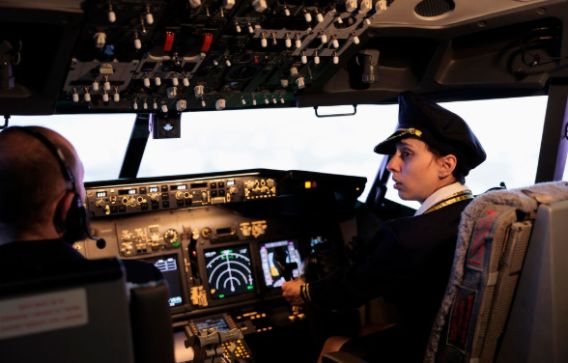
Commercial pilot training doesn’t happen in one step. It builds progressively, with each stage adding new skills and unlocking the next level of certification.
Stage 1: Private Pilot License (PPL)
The PPL is your entry point. It allows you to fly single-engine aircraft under visual flight rules (VFR) and carry passengers—though not for compensation. To earn your PPL, you’ll need a minimum of 40 flight hours (the national average is closer to 60–70), including at least 20 hours with an instructor and 10 hours of solo flight.
Many students begin their training at local flight schools. If you’re based in Texas, aviation schools in Dallas offer strong programs with certified flight instructors and well-maintained training fleets to help you build your foundational skills efficiently.
Stage 2: Instrument Rating (IR)
Once you hold a PPL, the next milestone is your Instrument Rating. This qualification allows you to fly in low-visibility conditions using only your aircraft’s instruments—a critical skill for any serious aviator. You’ll need at least 50 hours of cross-country flight time as pilot-in-command and 40 hours of actual or simulated instrument flight.
The IR substantially expands your capability and safety as a pilot. It’s also a prerequisite for commercial training.
Stage 3: Commercial Pilot License (CPL)
The CPL is where things get professional. To qualify, you must:
- Be at least 18 years old
- Have logged a minimum of 250 total flight hours
- Hold a valid Instrument Rating
- Pass a written knowledge test and a practical checkride
The 250-hour requirement includes specific mandates: at least 100 hours in powered aircraft, 100 hours as pilot-in-command, and 50 hours of cross-country flight. The FAA is precise about these distinctions, so logging your hours correctly matters.
Why Flight Hours Matter—and How to Build Them
Flight hours aren’t just a number on a form. They represent the breadth of your experience across different conditions, aircraft types, and operational environments. The FAA requires diversity in your logged hours for good reason—real-world flying rarely looks like a clear-sky afternoon training circuit.
Building your hours strategically pays dividends. Cross-country flights, night flying, and complex aircraft experience all contribute to a stronger, more versatile flight record. Many students find that earning a Certified Flight Instructor (CFI) certificate after their CPL is one of the most effective ways to accumulate hours while getting paid to do it.
Written Exams and Practical Checkrides
Alongside your flight training, you’ll face a series of written knowledge tests administered by the FAA. These cover topics like aerodynamics, navigation, meteorology, federal aviation regulations, and emergency procedures. Preparation typically involves self-study, ground school courses, or a combination of both.
Once you pass the written exam, you’ll complete a practical checkride with an FAA Designated Pilot Examiner (DPE). This is a two-part evaluation: an oral examination followed by an in-flight skills test. The examiner will assess whether you can apply everything you’ve learned—not just recall it.
Don’t underestimate the oral component. Examiners dig into your decision-making process, not just your technical knowledge. Pilots who approach the checkride with real situational awareness—not just memorized answers—tend to perform better.
Career Pathways After Certification

Earning your CPL opens several doors, and most commercial pilots begin with one of these two routes:
Flight Instructing: Becoming a CFI is the classic starting point. It keeps you flying, builds your hours, and pays reasonably well while you work toward the 1,500 hours required for an ATP certificate.
Regional Airlines: Regional carriers such as SkyWest, Envoy, and Horizon Air hire commercial pilots and often provide pathways to major airlines. Many regional airlines have reduced their minimum hour requirements in recent years to address pilot shortages, making entry more accessible for newly certified pilots. As pilots progress in their careers and begin earning higher salaries, many also start planning their finances and exploring investment opportunities, including strategies like navigating bond investments to build long-term financial stability.
Conclusion
Now that you have a better understanding of the different types of pilots and their career paths, it’s important to remember that there is no one right path to becoming a pilot. Each individual’s journey will be unique and may involve a combination of these options.